Institute of Archaeology Institute of Archaeology |
[Slovenian] |
| Home | Members | Programme | Projects | Laboratory |
| Database | Publications | Library | Links | Archive |
|
INTERESTING ARCHAEOLOGICAL FINDS ON THE LJUBLJANSKO BARJE, SLOVENIA The Ljubljana marsh (Ljubljansko barje) lies to the south-west of Ljubljana, the capital of Slovenia. Today it is a flood plain, but in the first part of the Holocene epoch it was a shallow lake. About 6500 to 4000 years ago people who built their dwellings on poles settled the area along the lake. The remnants of one such settlement lie in the fallow fields of Stare gmajne near Verd in the south-west of the Ljubljansko barje.
The prehistoric settlement of Stare gmajne is situated in the southwestern part of the Ljubljansko barje. The site was found by chance in 1992. A team from the Institute of Archaeology ZRC SAZU, lead by Dr. Anton Velušček, took samples and documented the archaeological wood in the drainage ditches at Stare gmajne from end of March to mid-April 2002. The relatively simple stratigraphy reveals a prehistoric layer lying on grey clay - most likely the lake's sediment.
There are also many wooden finds at Stare gmajne, the most important of which are two canoes and, in particular, a wheel with its axle.
Dating the settlement
Basic data on the most important find
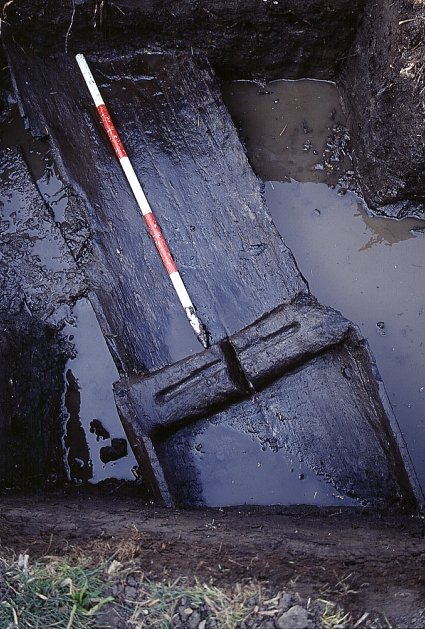
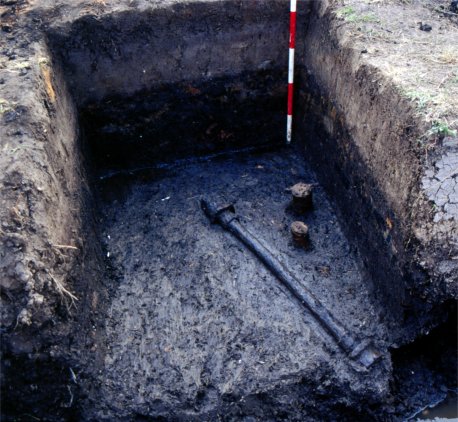
The wheel was situated slightly askew at the foot of the ditch where it had often suffered the reach and damage of a backhoe excavator, so called ditch- digging machine or JCB. Upon deepening the ditch the wheel fell off its axle and suffered further damage. The next probe was established in the direction of the axle and covering a surface of approximately 1,2 x 1,4 m; an exceptionally rich cultural layer was discovered 30 cm beneath the surface, revealing large amounts of housing roughcast, ashes and pottery finds characteristic of Stare gmajne. Individual pottery fragments and fragments of stone hammer-form axes with holes were also discovered in the gray clay soil just beneath the cultural layer. Still in the gray clay soil and 10 to 15 cm beneath the cultural layer was also the axle, preserved in its entirety.
The stratigraphic location of the wheel and axle thus indicates that they may be attributed to the prehistoric settlement. The wheel plate
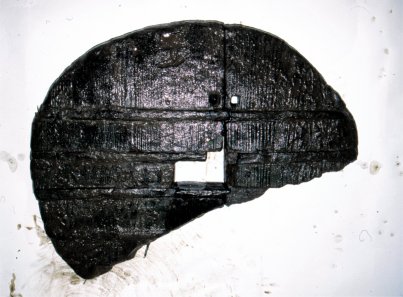
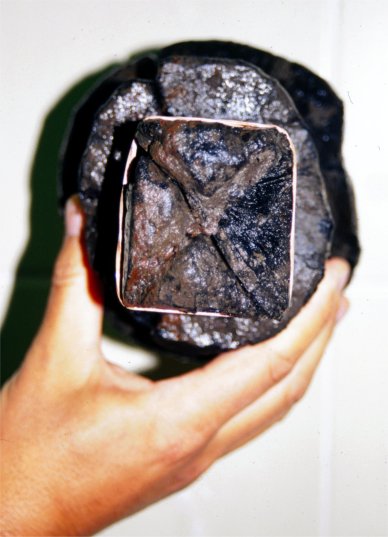
Wood. The diameter of the wheel is 72 cm. It consists of three plates with a square opening in the middle. The plate is 5-cm thick in the middle and gets thinner towards the rim. Four battens made of oakwood hold the plates together. The grooves for the battens are approximately 2 cm deep. Two plates were additionally bound together, most probably with a rope. There are two holes on the place where the plates touch. The rope has not been preserved. Approximately two thirds of the wheel is preserved. The Axle
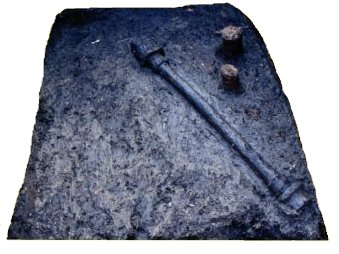
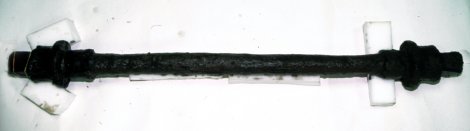
Wood. Length: 124 cm, slightly damaged, but preserved as a whole. The axle is symmetrical. The two end pieces, which have a rectangular cross-section (6 x 5.5 cm) and are 7-cm long, match the opening in the wheel. There are double wood wedges in both end pieces.
The rectangular end pieces continue into the central part of the axle, which has a circular cross-section. There are three sections with larger diameters between the end pieces and the central part of the axle: the first is 5 cm in length and 10.5 cm in diameter; the second is 3.5 cm in length and 14 cm in diameter; and the third is 7 cm in length and 8.5 cm in diameter. The central part of the axle is 79 cm in length and varies from 5.5 to 6 cm in diameter. |